
Custom Website vs WordPress: Which Is Right for Your Business?
Custom website development vs WordPress compared on speed, security, SEO, cost and scalability — with a clear framework for Indian businesses choosing a build.

Summary of this article
- Compares WordPress and custom-coded websites on speed, Core Web Vitals, security, maintenance and SEO control.
- Shows why the three-year total cost of hosting, premium plugins, fixes and redesigns matters more than the launch quote.
- Explains when WordPress is the sensible choice and when portals, integrations or performance justify a custom build.
- Closes with a simple decision framework and the option of a custom frontend on a headless CMS.
Summarised by AI from the full article. Check figures and prices against the article before you act on them.
Quick answer
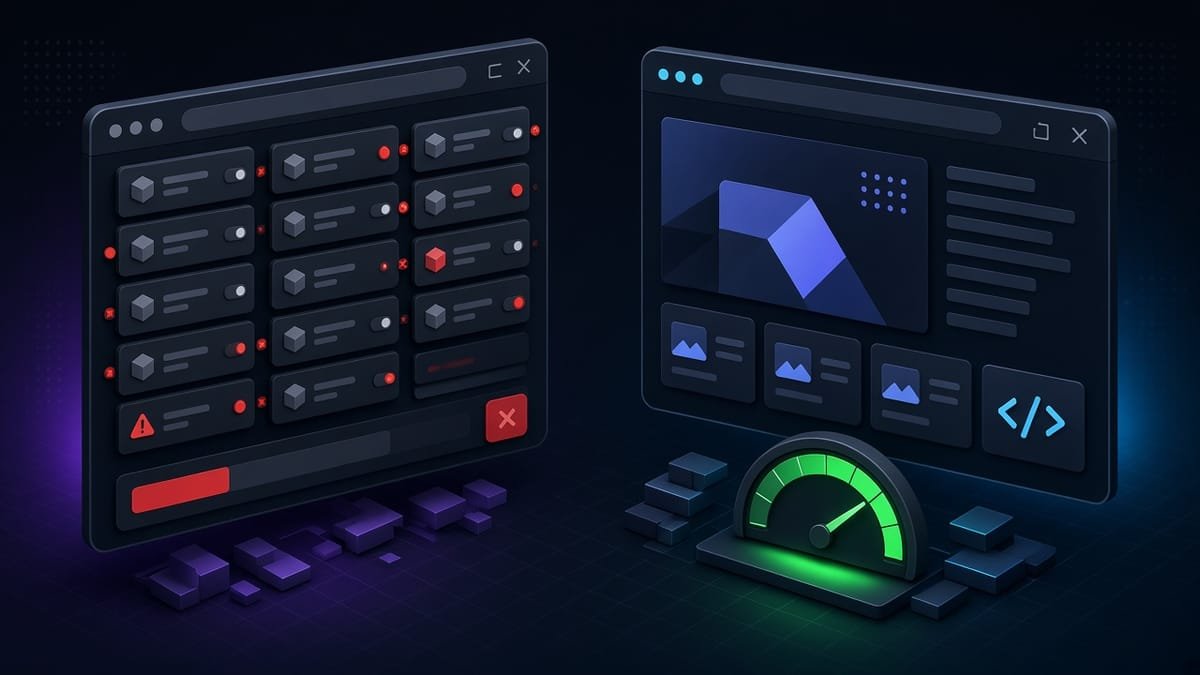
Choose WordPress if you need a simple content site quickly on a tight budget and are willing to maintain plugins. Choose custom website development if speed, security, unique workflows, integrations or long-term SEO matter to revenue — custom code costs more upfront but usually costs less to run and scale over three to five years.
Key takeaways
- WordPress is fastest to launch for simple brochure or blog sites, but plugin stacks slow pages and add security upkeep.
- Custom builds control every byte, so Core Web Vitals, schema and page structure can be engineered for search from day one.
- Compare total cost over three years — hosting, premium plugins, fixes and redesigns — not just the launch quote.
- If your site needs portals, calculators, CRM or ERP integrations, custom development avoids fragile plugin workarounds.
- A hybrid is possible: a custom frontend with a headless CMS keeps editing easy without theme bloat.
On this page
- What is the difference between WordPress and a custom website?
- Speed and Core Web Vitals
- Security and maintenance
- SEO: structure, schema and control
- Cost: launch price vs three-year total
- Features and integrations
- When WordPress is the right choice
- When custom website development is worth it
- A simple decision framework
Every growing business eventually asks the same question: should our website run on WordPress, or should we invest in custom website development? Both can work. The right answer depends on what the website has to do for your business — publish content, generate leads, sell products, or run workflows — and how much speed, security and search visibility are worth to you.
This guide compares the two honestly, using the criteria we see decide real projects for Indian businesses.
What is the difference between WordPress and a custom website?
WordPress is a content management system. Most business sites built on it use a pre-made theme plus plugins for forms, SEO, caching, sliders, security and page building. You assemble features rather than build them.
A custom website is engineered for your specific requirements — typically with modern HTML, TypeScript and a framework such as Angular, React or Next.js, often with server-side rendering. Every page template, component and integration exists because your business needs it. Content can still be editable through a headless CMS or a lightweight admin panel.
The practical difference is control. With WordPress you inherit decisions made by theme and plugin authors. With custom development, your team makes every decision about structure, performance and features.
Speed and Core Web Vitals
Page speed affects both rankings and conversions. Google's Core Web Vitals measure loading (Largest Contentful Paint, target 2.5 seconds or less), responsiveness (Interaction to Next Paint, target 200 ms or less) and visual stability (Cumulative Layout Shift, target 0.1 or less).
WordPress sites commonly struggle here because:
- Page builders output deeply nested markup and large CSS files.
- Each plugin can add its own scripts and stylesheets to every page.
- Sliders, popups and chat widgets block the main thread on mobile.
A custom build ships only the code a page needs. Images are sized and lazy-loaded properly, critical CSS is inlined, and rendering can happen on the server so content appears immediately. Passing Core Web Vitals becomes a design decision rather than a constant fight with caching plugins.
Security and maintenance
WordPress powers a large share of the web, which makes it a frequent target. Most compromises come through outdated plugins or themes, not WordPress core. That means someone has to update plugins regularly, test that updates do not break the layout, and monitor for vulnerabilities.
Custom websites have a smaller attack surface: no public plugin ecosystem, no default admin URL to brute-force, and fewer third-party dependencies. They still need maintenance — dependency updates, hosting patches and backups — but the work is predictable and scoped.
SEO: structure, schema and control
Good SEO starts with technical foundations: crawlable HTML, logical URL structure, fast rendering, internal linking and structured data. You can achieve these on WordPress with discipline and the right plugins, but many sites end up with duplicate archive pages, bloated markup and conflicting schema from multiple plugins.
With custom development, the site architecture follows your keyword and search-intent map. Each service or location page gets the headings, schema and internal links it needs. Our technical SEO checklist covers the signals that matter most, and a custom build lets you implement all of them cleanly.
Cost: launch price vs three-year total
WordPress usually wins on launch price. A theme-based site can go live quickly and cheaply. But the fair comparison is total cost of ownership over three years:
| Cost area | WordPress site | Custom website |
|---|---|---|
| Initial build | Lower | Higher |
| Premium plugins and theme renewals | Recurring yearly | Rarely needed |
| Security fixes and plugin conflicts | Frequent, unplanned | Rare, planned |
| Speed optimisation | Ongoing workarounds | Built in |
| Redesign or rebuild | Often every 2–3 years | Iterative upgrades |
For a simple brochure site, WordPress often stays cheaper. For a site that drives leads or sales, the recurring costs and lost conversions from a slow site usually close the gap within a couple of years.
Features and integrations
Where custom development clearly wins is anything beyond pages and blog posts:
- Dealer or client portals with logins and role-based access
- Quote builders, calculators and product configurators
- CRM, ERP, payment gateway or WhatsApp API integrations
- Multi-step lead forms with conditional logic and validation
On WordPress these usually mean stacking plugins that were never designed to work together. A custom build implements the workflow directly, with proper data handling and testing.
When WordPress is the right choice
WordPress is a sensible choice when:
- You need a content-heavy blog or simple brochure site quickly.
- Budget is tight and the website is not a primary revenue channel.
- Your team already knows WordPress and can maintain it responsibly.
- You do not need complex integrations or custom workflows.
When custom website development is worth it
Custom development makes sense when:
- The website is a core lead-generation or sales channel.
- Mobile speed and search rankings directly affect revenue.
- You need portals, integrations or features plugins cannot do cleanly.
- Brand presentation matters and a theme would look like competitors.
If that sounds like your business, our custom website development service starts with workflow discovery and a domain model before any design work, so the build fits how you actually operate. For simpler marketing sites, our website development service delivers fast, SEO-ready business websites.
A simple decision framework
Ask these five questions:
- What must the site do? Publish content, capture leads, sell, or run workflows?
- How much revenue depends on it? The higher the dependency, the more speed and reliability matter.
- What integrations are needed? Each one pushes toward custom.
- Who will maintain it? Plugin updates need an owner.
- What is the three-year cost? Include plugins, fixes and redesigns.
If most answers point to content and low integration needs, choose WordPress. If they point to revenue, performance and custom workflows, choose a custom build — or a hybrid with a custom frontend and a headless CMS for easy editing.
Frequently asked questions
Is a custom website better for SEO than WordPress?
Not automatically, but it removes the usual blockers. Custom code lets you control HTML structure, page weight, rendering and schema directly, which makes passing Core Web Vitals and building clean site architecture much easier than fighting a heavy theme and a dozen plugins.
How much does custom website development cost in India?
Indicative ranges: a focused custom business site of 8–15 pages typically starts in the low lakhs, while sites with portals, calculators or integrations cost more. The honest comparison is three-year total cost, because WordPress sites often need paid plugins, security fixes and redesigns that close the gap.
Can I edit a custom website myself without a developer?
Yes, if it is built with a CMS layer. We connect custom frontends to a headless CMS or a simple admin so your team can update text, images, blogs and landing pages without touching code.
Should I migrate my existing WordPress site to a custom build?
Migrate when WordPress is actively costing you — slow mobile pages, repeated plugin conflicts, security incidents or features you cannot build cleanly. Keep URLs and redirects mapped so existing Google rankings carry over.
How long does a custom website take to build?
A typical custom business website takes four to eight weeks from discovery to launch, depending on page count, content readiness and integrations.
Want Custom Website Development done right?
Get a free consultation and a clear plan — scope, timeline and cost — from our Mumbai team.