Custom Software vs Off-the-Shelf: How to Decide in India
Custom software vs off-the-shelf software compared on cost, fit, integrations and risk, with a decision framework built for Indian SMEs and growing teams.

Summary of this article
- Contrasts packaged tools, which you adapt to, with custom software built around your own rules, roles and data.
- Lists when to buy (a standard process, about 80% fit, need for speed) and when to build (spreadsheet workarounds, rising per-user fees, client portals, audit needs).
- Includes a side-by-side comparison table, indicative Indian build-cost ranges and the risks of each route, including the DPDP Rules, 2025.
- Gives a five-step decision framework and explains why a hybrid of packaged and custom software often works best.
Summarised by AI from the full article. Check figures and prices against the article before you act on them.
Quick answer
Buy off-the-shelf software when your process is standard, such as accounting, payroll or basic CRM, and a packaged tool covers about 80% of it. Build custom software when the workflow is your competitive edge, when workarounds cost more than the tool, or when integrations and data ownership matter. Many Indian SMEs do best with a hybrid.
Key takeaways
- Off-the-shelf software wins on speed and upfront cost for standard processes like accounting, payroll and email.
- Custom software wins when your workflow is unique, your team keeps patching tools with spreadsheets, or per-user fees grow faster than revenue.
- Compare total cost over three to five years: licences, add-ons, workarounds, integrations and migration, not just the first quote.
- A hybrid is often best: keep packaged tools for commodity functions and build custom software only for the workflow that differentiates you.
- Write down the top five workflow pain points before talking to any vendor or developer; it makes both options easier to judge.
On this page
- What is the difference between custom and off-the-shelf software?
- When does off-the-shelf software make sense?
- When does custom software make sense?
- Custom software vs off-the-shelf: a side-by-side comparison
- How much does each option cost over time?
- What risks should you check before you choose?
- A five-step framework to decide
- Is a hybrid approach better?
- How Arham Technology approaches custom software
- Next step: decide on one process
Every growing business reaches a point where the tools it bought no longer match the way it works. Orders sit in one sheet, approvals in WhatsApp threads, and invoices in an accounting package that nobody else can read. The question of custom software vs off-the-shelf software then decides how much time and money you spend for the next few years.
This guide gives you a practical way to decide. It covers what each option really costs, where each one fails, and a short framework you can apply to your own process before you speak to a vendor or a development team.
What is the difference between custom and off-the-shelf software?
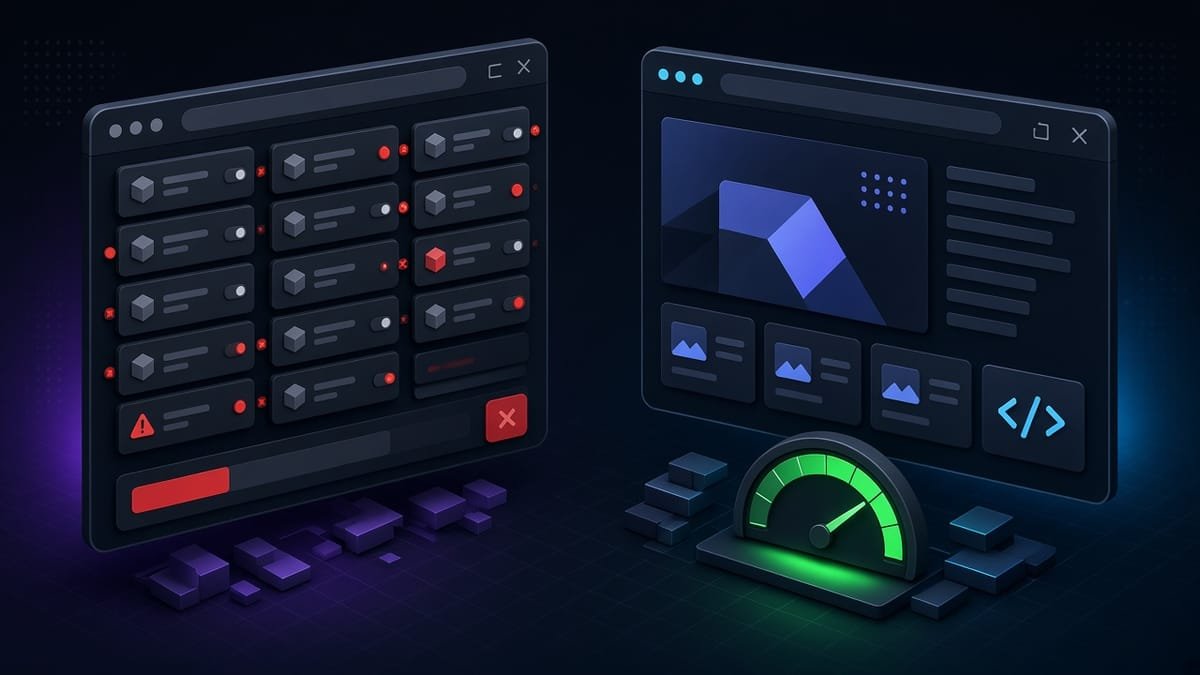
Off-the-shelf software is a ready-made product sold to many businesses, usually as a subscription, such as accounting, CRM, HR or project-management tools. You adapt your process to the product, within the settings it allows.
Custom software is built for one organisation's rules, roles and data. It might be a client portal, an approval system, an order desk or an internal dashboard. The product adapts to your process rather than the other way round.
The practical difference is who holds the compromise. With packaged tools, your team bends to the software. With custom software, the design effort moves upfront so the team does not have to bend later.
When does off-the-shelf software make sense?
Off-the-shelf software makes sense when your process is common, your needs are stable, and a tool already covers most of them. Accounting, payroll, email, e-signature and basic project tracking are classic examples, since every business runs them in roughly the same way.
Buy packaged software when:
- A vendor product fits about 80% of your process without heavy customisation.
- You need to be live in days or weeks, not months.
- The function is not a source of competitive advantage.
- You prefer the vendor to handle updates, hosting and compliance changes.
Packaged tools are also cheaper to test. You can trial several, learn what you actually need, and only then decide whether a gap is worth building for.
When does custom software make sense?
Custom software makes sense when your workflow is unusual, tightly tied to revenue, or held together by manual workarounds. The clearest signal is a person whose real job is to move data between tools.
Consider a custom build when:
- Staff maintain parallel spreadsheets because the tool cannot model your rules.
- You pay for several subscriptions that still need manual copy-paste between them.
- Per-user pricing grows faster than your revenue as the team scales.
- A client-facing portal, dealer login or approval chain is part of your service.
- You need an audit trail, role-based permissions or data stored on your terms.
A common pattern for Indian SMEs is an order, dispatch or job-tracking process that sits between a sales tool and an accounting package. Neither product owns it, so it ends up in Excel. That gap is usually the best first candidate for custom software.
Custom software vs off-the-shelf: a side-by-side comparison
| Factor | Off-the-shelf software | Custom software |
|---|---|---|
| Time to start | Days to weeks | Weeks to months |
| Upfront cost | Low | Higher |
| Ongoing cost | Licences, often per user | Hosting, support, enhancements |
| Fit to your process | Partial, you adapt | High, built around you |
| Integrations | Limited to what the vendor supports | Designed for your stack |
| Control of roadmap | Vendor decides | You decide |
| Data ownership and export | Depends on the vendor | Yours by design |
| Main risk | Workarounds and lock-in | Scope creep and poor adoption |
Neither column wins every row. The right choice depends on which rows matter most to your business.
How much does each option cost over time?
The fair comparison is total cost over three to five years, not the first invoice. Packaged software looks cheap in month one, but costs accumulate through per-user licences, higher tiers for features you need, paid add-ons, implementation help and the staff time spent on workarounds.
Custom software front-loads the cost into design and build, then charges for hosting, support and improvements. Indicative ranges, based on typical project experience and varying widely with scope:
| Scope | Indicative custom build cost (India) |
|---|---|
| Single-workflow tool or internal dashboard | ₹2,00,000–₹6,00,000 |
| Multi-role portal with approvals and reports | ₹6,00,000–₹15,00,000 |
| Larger platform with several integrations | ₹15,00,000 and above |
These are estimates, not quotes. For a simple, standard need, a subscription will almost always be cheaper. For a process that needs several tools plus manual effort to hold them together, custom software can cost less over time. If you are also weighing a product for external customers, our SaaS MVP cost guide explains how those budgets differ.
What risks should you check before you choose?
Each route has its own failure modes, and most can be reduced with a little planning.
Risks with off-the-shelf software
- Lock-in. Moving away is painful if you cannot export clean data.
- Feature drift. The vendor may change pricing, remove features or sunset a plan.
- Customisation traps. Heavy tweaking can cost nearly as much as a build and still leaves you on someone else's roadmap.
Risks with custom software
- Scope creep. Every stakeholder adds one more idea. Lock a phase-one outcome and keep a visible backlog.
- Low adoption. Software that staff dislike gets bypassed. Involve the real users early.
- Key-person dependency. Insist on documentation, source-code ownership and a maintenance plan.
Data protection matters for both. India's Digital Personal Data Protection Rules, 2025 were notified in November 2025, and most duties for organisations handling personal data, such as notices, consent, security safeguards and breach intimation, apply after an 18-month transition. Check the official rules published by MeitY and ask any vendor or developer where your data is stored, who can access it and how it is deleted.
A five-step framework to decide
Use this checklist on the process you want to fix, not on your whole business.
- Map the process. List the steps, the people, the tools and the handoffs. Watch a real week of work if you can.
- Score the fit. Try two or three packaged tools. If one covers around 80% of the steps without hacks, buy it.
- Price the gap. Estimate the monthly staff hours lost to workarounds and errors, and the annual licence cost at your planned headcount.
- Check the integrations. List the systems it must talk to, such as Tally, your CRM, payment gateways or WhatsApp, and confirm each is supported.
- Pick the smallest commitment. Buy the tool, or build a phase-one version of the custom system, and review after one quarter.
If the gap in step three is larger than the cost of a phase-one build, custom software is worth a serious look.
Is a hybrid approach better?
For many businesses, yes. A hybrid approach keeps packaged software for commodity functions and builds custom software only for the workflow that sets you apart. You might run accounting in Tally, marketing in a CRM and a custom order desk that feeds both.
The glue is an API layer or a small backend that syncs data between the tools. Our backend development service covers that kind of integration work, and our comparison of a custom website vs WordPress applies the same build-or-buy logic to websites.
How Arham Technology approaches custom software
We start with the process, not the screens. The steps below reflect how our custom software development service is delivered:
- Ops shadowing. We observe a live week of work to catch handoffs that workshops miss.
- Priority backlog. Pain points are ranked by frequency and business risk so phase-one scope stays honest.
- Prototype in context. Clickable flows are tested with the people who will use them before deep engineering starts.
- Build and data migration. Core modules ship with careful import of historical records and parallel-run support.
- Adoption coaching. We train champions, gather friction notes and fix the interface before full cutover.
Typical deliverables include process maps with exception paths, role-based web applications, bridges from Excel or legacy databases, email, SMS or WhatsApp Business notifications, reporting views and admin guides. We also tell you when a packaged tool is the better answer, because that is cheaper for you than a build you did not need.
Next step: decide on one process
Pick the single process that hurts most and run the five-step framework on it this week. If a packaged tool fits, buy it. If the gap is real, talk to us about custom software development and contact our team with the workflow. We will propose a phase-one scope, a migration approach and an indicative budget so you can compare it honestly against the tools you already pay for. If the same system will eventually serve outside customers, our SaaS development service is the natural next conversation.
Frequently asked questions
Is custom software better than off-the-shelf software?
Neither is better in general. Off-the-shelf software is better for standard needs that many businesses share. Custom software is better when your process is distinctive, when you need deep integrations, or when packaged tools force costly workarounds.
When should a small business build custom software?
Build when a core process keeps breaking in spreadsheets, when you pay for several tools that still do not talk to each other, or when a single workflow drives revenue or service quality. If a packaged tool fits most of your process, buy it first.
Is custom software more expensive than off-the-shelf software in India?
Upfront, yes. Custom software needs a build budget, while packaged tools charge monthly or yearly licences. Over three to five years the gap narrows, because licences are charged per user, add-ons and customisation fees accumulate, and workarounds consume staff time.
Can custom software integrate with Tally, Zoho or WhatsApp?
Yes. Custom software can connect to Tally, CRMs, payment gateways and the WhatsApp Business Platform through their APIs or export formats. Integration difficulty depends on what the other tool exposes, so check it during scoping.
Can I start with off-the-shelf software and switch to custom later?
Yes, and it is often sensible. Use a packaged tool to learn the process, export your data regularly, and build custom software once you know exactly which gaps cost you money. Confirm early that you can export your data in a usable format.
Want Custom Software Development done right?
Get a free consultation and a clear plan — scope, timeline and cost — from our Mumbai team.